If you’ve spent any time on TikTok, YouTube Shorts, Twitch streams, or gaming communities, you’ve probably heard someone say, “That’s a Fanum Tax.”
At first, the phrase sounds confusing. Is it an actual tax? Is it a joke? Is it internet slang with a hidden meaning?
The truth is that Fanum Tax is one of the most popular Gen Z expressions to emerge from online culture in recent years. It started as a funny inside joke but quickly became part of everyday internet language.
People search for the meaning because they hear it in videos, comments, memes, and conversations but often struggle to understand what it actually means. This guide explains the definition, origin, examples, and cultural significance behind the phrase.
Fanum Tax Meaning – Quick Meaning
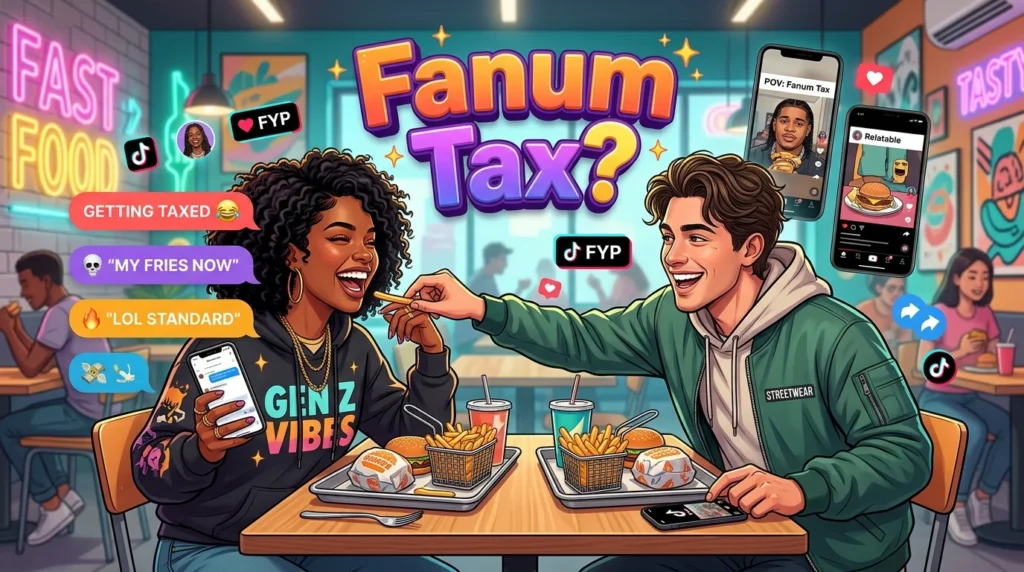
Fanum Tax refers to taking a small portion of someone else’s food, snacks, or possessions as a joke, usually without serious permission.
The phrase is mostly used humorously among friends.
Simple Definition
- Taking a bite of a friend’s food
- Stealing a few fries as a joke
- Claiming a small share of something
- Playfully helping yourself to another person’s snack
Examples
“You bought pizza? Time for the Fanum Tax.”
“Give me one fry. That’s the Fanum Tax.”
“I only took one chip. Fanum Tax rules.”
The phrase is not meant to be taken literally. It usually represents playful friendship behavior.
Skibidi Fanum Tax Meaning
The phrase “Skibidi Fanum Tax” became popular because internet users started combining multiple viral memes into one sentence.
“Skibidi” comes from the viral Skibidi Toilet trend, while “Fanum Tax” comes from a separate online joke. Together, they often appear in absurd Gen Z humor where the goal is not always logical meaning but entertainment.
Many younger users say “Skibidi Fanum Tax” simply because it sounds funny and instantly signals familiarity with internet culture.
In most situations, the phrase functions more as a meme than a meaningful expression.
Fanum Tax Meaning TikTok
TikTok played a major role in spreading Fanum Tax worldwide.
Short videos showing friends stealing food, taking snacks, or jokingly demanding a share of someone’s meal frequently used the phrase. The combination of humor, relatability, and repeatability helped it become viral.
Today, TikTok users often comment:
- “Fanum Tax activated.”
- “Bro paid the Fanum Tax.”
- “That’s the biggest Fanum Tax ever.”
The phrase has become part of TikTok’s everyday slang vocabulary.
Fanum Tax Meaning Gen Z
For Gen Z, Fanum Tax represents more than taking food.
It symbolizes playful friendship dynamics where sharing, teasing, and joking create social bonds. The phrase reflects a communication style built around humor and shared internet references.
Many Gen Z expressions gain popularity because they create a sense of belonging. Using Fanum Tax shows familiarity with online trends and meme culture.
That is one reason the phrase spread so quickly across social media platforms.
Fanum Tax Meaning Urban Dictionary
According to common Urban Dictionary interpretations, Fanum Tax refers to the act of taking a portion of someone else’s food as a humorous “tax.”
Most definitions emphasize that the action is playful rather than malicious.
The phrase is often associated with:
- Friendship
- Gaming communities
- Streaming culture
- Meme humor
- Online entertainment
Urban Dictionary entries helped introduce the term to users who encountered it outside social media videos.
Fanum Tax Origin
The origin of Fanum Tax can be traced to content creator and streamer Fanum.
Fanum became known for jokingly taking food from friends during videos and livestreams. Viewers noticed the recurring behavior and began calling it the “Fanum Tax.”
What started as an inside joke among fans eventually spread throughout the internet.
As clips were reposted across TikTok, YouTube, Instagram Reels, and meme pages, millions of users adopted the phrase.
Today, many people use Fanum Tax without even knowing who Fanum originally is.
Fanum Meaning
The word “Fanum” itself comes from the online personality Fanum.
It is not originally a dictionary word connected to taxes or finance. Instead, the internet attached a new meaning to his name because of the recurring joke involving food sharing.
Over time, the name became part of a larger internet expression.
This transformation is common in online culture, where names, catchphrases, and moments often evolve into slang terms.
Fanum Tax Pronunciation
Fanum Tax is usually pronounced as:
FAN-um Taks
Phonetic pronunciation:
/ˈfænəm tæks/
Most people say it naturally as two separate words:
Fanum + Tax
The phrase is easy to pronounce, which helped contribute to its popularity across social media platforms.
Fanum Tax Meaning Example
Understanding the phrase becomes easier when you see it in context.
Example 1
Friend 1: “I just bought a burger.”
Friend 2: “Give me a bite.”
Friend 1: “Seriously?”
Friend 2: “Fanum Tax.”
Example 2
Person A: “Those fries look good.”
Person B: “Don’t touch them.”
Person A: takes one fry
Person B: “You just paid the Fanum Tax.”
Example 3
Student A: “I brought snacks for lunch.”
Student B: “Looks like Fanum Tax season.”
These examples show that the phrase is usually playful and friendly rather than serious.
Real-Life Conversations
WhatsApp Conversation
Person A: Just got a large pepperoni pizza.
Person B: Nice. Save me two slices.
Person A: You didn’t pay for it.
Person B: Doesn’t matter. Fanum Tax applies to everyone.
Instagram DM Conversation
Person A: Check out this giant milkshake I ordered.
Person B: Looks amazing.
Person A: Wish you were here.
Person B: I’d already be collecting my Fanum Tax.
TikTok Comments
Creator: Finally bought my favorite snacks.
Commenter 1: Fanum Tax incoming.
Commenter 2: Nobody’s snacks are safe.
Creator: You’re all getting blocked.
Text Message Conversation
Person A: I brought cookies for the road trip.
Person B: Great. Hand one over.
Person A: We just started driving.
Person B: Fanum Tax never waits.
Emotional & Psychological Meaning
At its core, Fanum Tax expresses playful entitlement between friends. It turns a small act of taking something into a shared joke that everyone understands.
People often use it to create connection. Instead of directly asking for food, they use humor to make the interaction feel lighter and more entertaining.
The phrase also reflects how modern friendships operate online. Shared memes become social shortcuts that instantly create familiarity and belonging.
Imagine sitting with friends after school. Someone opens a bag of chips and another friend immediately reaches in while shouting “Fanum Tax.” Everyone laughs because they recognize the joke. The snack matters less than the social interaction itself.
Usage in Different Contexts
Social Media
Fanum Tax is most commonly used on TikTok, Instagram, YouTube Shorts, Twitch, and meme pages.
Users often comment on food videos by joking that the creator owes viewers a Fanum Tax.
Friends and Relationships
Among friends, the phrase is used playfully when sharing food, drinks, snacks, or even small possessions.
It creates a lighthearted atmosphere and often strengthens group bonding.
Work or Professional Settings
Using Fanum Tax at work depends on the audience.
Younger coworkers familiar with internet culture may understand it, but many professional environments may find it confusing or inappropriate.
Casual vs Serious Tone
Fanum Tax is almost always casual.
It should be treated as a joke rather than a serious request. Using it in serious conversations can create confusion because the phrase is rooted in humor.
When NOT to Use It
There are situations where Fanum Tax may not be appropriate.
Professional Communication
Avoid using it in formal emails, presentations, or client interactions.
Not everyone understands internet slang.
Around Strangers
The joke works best among friends who share the same cultural references.
Using it with strangers may appear rude rather than funny.
During Serious Discussions
The phrase can seem insensitive when conversations involve important or emotional topics.
Cultural Contexts
Some cultures place greater importance on personal boundaries and ownership. What feels playful in one group may feel disrespectful in another.
Common Misunderstandings
Thinking It’s a Real Tax
Many people first assume Fanum Tax has something to do with money or government taxes.
In reality, it has nothing to do with finance.
Assuming It’s Theft
The phrase refers to joking behavior among friends.
It does not encourage actual stealing.
Believing Everyone Understands It
While popular online, many people outside Gen Z internet culture have never heard the phrase.
Confusing It With Other Meme Terms
Internet slang changes rapidly. Fanum Tax is often mixed with unrelated meme expressions because they became popular around the same time.
Comparison Table
| Term | Definition Intent |
|---|---|
| What Does Fanum Tax Mean? | A humorous phrase for taking a small share of someone’s food or item |
| How to Use Fanum Tax | Use it jokingly among friends when asking for a portion of something |
| Examples of Fanum Tax | “Give me one fry. That’s Fanum Tax.” |
| Fanum Tax vs Sharing | Sharing is voluntary; Fanum Tax is a playful joke about claiming a portion |
| Fanum Tax vs Borrowing | Borrowing implies returning something; Fanum Tax usually involves food |
| Fanum Tax vs Mooching | Mooching may be viewed negatively; Fanum Tax is generally playful |
Key Insight
Fanum Tax succeeds because it transforms an ordinary act—taking a bite of food—into a shared cultural joke. The humor is what makes the phrase memorable and widely used.
Variations and Types
Fanum Tax Meaning
The playful act of claiming a small share of someone else’s food or belongings.
Fanum Tax in Text
Used in messages to jokingly request part of what someone has.
Fanum Tax Abbreviation
There is no widely accepted abbreviation, but some users simply type “FT.”
Fanum Tax Slang
Internet slang associated with friendship, memes, and online culture.
Fanum Tax in Chat
Common in gaming chats, group chats, and social media comments.
Fanum Tax Meme
A meme format centered on stealing a bite or portion of food.
Fanum Tax TikTok
The version most users encounter through viral TikTok videos.
Fanum Tax Trend
Refers to the broader online phenomenon surrounding the phrase.
Fanum Tax Joke
Used humorously rather than literally.
Fanum Tax Reference
A cultural reference that signals familiarity with Gen Z internet humor.
How to Respond When Someone Uses It
Casual Replies
- “Take one and that’s it.”
- “Fine, but only one bite.”
- “I expected this.”
Funny Replies
- “Fanum Tax rates just increased.”
- “You’ll receive an invoice.”
- “Tax collection is suspended.”
Mature Replies
- “Sure, let’s share.”
- “Help yourself.”
- “No problem, I’ve got plenty.”
Respectful Replies
- “Would you like some?”
- “Feel free to take a small portion.”
- “I’m happy to share.”
Regional and Cultural Usage
Western Culture
The phrase is widely recognized among younger internet users in North America and parts of Europe.
Asian Culture
Awareness is growing through TikTok, YouTube, and gaming communities, although usage remains more niche.
Middle Eastern Culture
Many younger social media users recognize the phrase, especially those active in meme and gaming spaces.
Global Internet Usage
Fanum Tax has become a global meme thanks to short-form video platforms.
Gen Z vs Millennials
Gen Z generally recognizes the phrase immediately.
Many Millennials understand it after seeing social media content, though they may use it less frequently.
Is It Safe for Kids?
Yes, Fanum Tax is generally considered safe for kids.
The phrase is typically harmless and revolves around humor, friendship, and food-sharing jokes. Parents should simply ensure children understand the difference between playful joking and respecting other people’s belongings.
FAQs
What does Fanum Tax mean in slang?
It means jokingly taking a small portion of someone else’s food or possessions.
Who created Fanum Tax?
The phrase originated from streamer Fanum and his recurring food-sharing jokes.
Why is Fanum Tax popular?
TikTok, Twitch, YouTube Shorts, and meme culture helped make it viral.
Is Fanum Tax a real tax?
No. It is an internet joke and has no connection to actual taxes.
What does Fanum Tax mean on TikTok?
It usually refers to jokingly claiming part of someone’s food or snack.
Is Fanum Tax a Gen Z term?
Yes. It is strongly associated with Gen Z internet culture and meme communities.
Can adults use Fanum Tax?
Absolutely. Anyone familiar with the joke can use it in casual situations.
What does Fanum tax mean?
Fanum Tax is internet slang that refers to jokingly taking a small portion of someone else’s food, snack, or item. It is usually used among friends in a playful way.
The phrase became popular through social media, where people use it to describe harmless “food stealing” as a joke. It is not a real tax and has nothing to do with money.
What is an example of a Fanum tax?
Imagine your friend buys a box of fries, and you take a few without asking. You smile and say, “That’s the Fanum Tax.”
Another common example is taking a bite of a friend’s pizza or snack and using the phrase to make the situation funny rather than serious.
Is Fanum tax a compliment?
Fanum Tax is generally not a compliment. It is a humorous expression used to joke about taking a small share of something, especially food.
However, it can indirectly show friendliness and comfort between people because it is most often used among close friends who enjoy joking with each other.
Is “Fanum Tax” related to Kai Cenat?
Yes, Fanum Tax is indirectly connected to Kai Cenat because he and Fanum are members of the content group AMP.
The phrase itself comes from Fanum’s habit of jokingly taking food from friends during videos and streams, which became a popular meme within the AMP community and spread across social media.
Conclusion
Fanum Tax is much more than a funny internet phrase. It represents how modern online culture turns everyday moments into shared experiences. What started as a simple joke involving food evolved into a global meme recognized by millions of people. Whether you see it in TikTok comments, gaming chats, or text messages, understanding Fanum Tax helps you stay connected with contemporary internet language. Now when someone reaches for your fries and says “Fanum Tax,” you’ll know exactly what they mean.