
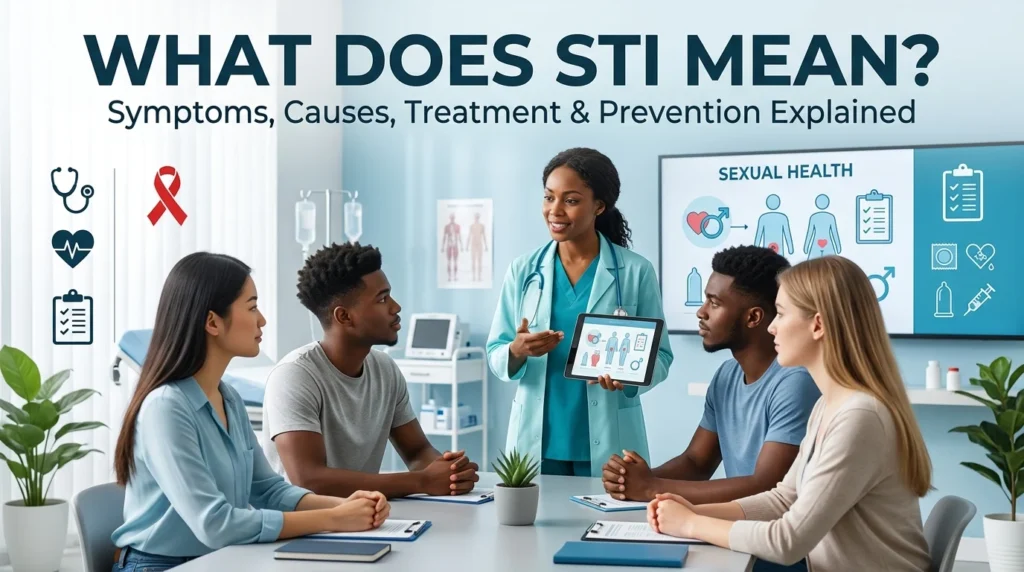
If you’ve ever searched “What does STI mean?” you’re not alone. The term appears in health articles, social media discussions, medical forms, and educational resources, yet many people still confuse it with STD.
Understanding what STI means is important because it relates directly to sexual health, prevention, and early treatment. Many people hear the term but aren’t sure what it includes, how it differs from an STD, or whether it should be a cause for concern.
This guide explains the meaning of STI, its causes, symptoms, treatments, and common misconceptions in a clear and practical way.
STI – Quick Meaning

STI stands for Sexually Transmitted Infection.
It refers to infections that spread primarily through sexual contact, including vaginal, oral, and anal sex.
Key points:
- STI means a person has an infection.
- Some STIs cause symptoms.
- Many STIs show no symptoms at all.
- Early testing helps prevent complications.
Examples:
“My doctor recommended an STI screening before starting a new relationship.”
“Many people have an STI without realizing it.”
“Regular STI testing is an important part of sexual health.”
Origin & Background
The term STI became more widely used by healthcare professionals in recent decades.
Previously, the term STD (Sexually Transmitted Disease) was more common. However, medical experts began using STI because a person can carry an infection without developing a disease or showing symptoms.
This shift helped create more accurate and less stigmatizing conversations around sexual health.
Social media, health campaigns, and educational websites have also contributed to the widespread use of STI. Today, younger generations are more likely to encounter the term STI than STD in health-related discussions.
Real-Life Conversations
WhatsApp Conversation
Person A: Have you ever had an STI test?
Person B: Yeah, I get tested regularly. It just gives me peace of mind.
Instagram DM
Person A: Is STI the same thing as STD?
Person B: Not exactly. STI is the infection itself, while STD usually refers to a disease caused by that infection.
TikTok Comments
Person A: Can someone have an STI and not know it?
Person B: Definitely. Some infections don’t show symptoms for months or even years.
Text Message
Person A: My doctor suggested an STI screening.
Person B: That’s smart. Early testing can catch things before they become serious.
Emotional & Psychological Meaning
Conversations about STIs often involve emotions such as anxiety, embarrassment, uncertainty, or concern about relationships.
Many people worry about judgment when discussing sexual health. However, health professionals view STI testing the same way they view routine health checkups.
A common real-life scenario involves someone starting a new relationship and deciding to get tested together with their partner. Instead of being a sign of distrust, it often reflects respect, honesty, and responsibility.
Modern communication is gradually making these conversations more open and less stigmatized.
Usage in Different Contexts
Social Media
Health creators frequently use STI when discussing prevention, symptoms, and testing.
Friends & Relationships
People often discuss STI testing when entering a committed relationship or after a potential exposure.
Work or Professional Settings
Healthcare professionals, educators, and counselors commonly use STI because it is medically accurate.
Casual vs Serious Tone
In casual conversations, STI may come up when discussing health awareness.
In serious situations, it usually refers to diagnosis, treatment, testing, or prevention.
STI Symptoms Female
Symptoms of an STI in women can vary depending on the infection.
Common symptoms may include:
- Unusual vaginal discharge
- Pelvic pain
- Burning during urination
- Pain during intercourse
- Genital itching
- Unusual bleeding between periods
- Sores or bumps around the genital area
It’s important to remember that many women experience no symptoms at all, which is why regular testing matters.
Symptoms of STD in Male
Men may experience different symptoms depending on the infection involved.
Common signs include:
- Burning sensation while urinating
- Discharge from the penis
- Pain or swelling in the testicles
- Genital sores or blisters
- Itching or irritation
- Pain during ejaculation
Like women, many men can carry an infection without noticeable symptoms.
STI Treatment
Most STIs can be treated effectively when diagnosed early.
Treatment depends on the specific infection:
- Bacterial infections often respond to antibiotics.
- Viral infections may be managed with antiviral medications.
- Some infections can be cured completely.
- Others can be controlled successfully with ongoing treatment.
Following medical advice and completing prescribed treatment is essential.
What Causes STI in Males
STIs in males are caused by exposure to infectious organisms during sexual contact.
Common causes include:
- Unprotected sexual activity
- Multiple sexual partners
- Contact with infected bodily fluids
- Skin-to-skin contact with infected areas
- Sharing needles in some cases
The causes are generally the same for both men and women.
What Are the Top 10 Sexually Transmitted Diseases
The most commonly discussed sexually transmitted infections and diseases include:
- Chlamydia
- Gonorrhea
- Syphilis
- Human Papillomavirus (HPV)
- Herpes Simplex Virus (HSV)
- HIV
- Hepatitis B
- Trichomoniasis
- Mycoplasma Genitalium
- Chancroid
Some are bacterial infections, while others are viral.
STI Causes
STIs can develop when bacteria, viruses, or parasites are transmitted from one person to another.
Common causes include:
- Vaginal sex
- Oral sex
- Anal sex
- Direct skin contact
- Blood exposure
- Mother-to-child transmission during pregnancy or birth
Risk increases when preventive measures are not used consistently.
Is STI Dangerous
An STI can become dangerous if left untreated.
Potential complications may include:
- Infertility
- Chronic pain
- Pregnancy complications
- Increased risk of other infections
- Organ damage in severe cases
The good news is that many complications can be prevented through early testing and treatment.
STI Examples
Examples of common STIs include:
- Chlamydia
- Gonorrhea
- Syphilis
- HIV
- HPV
- Herpes
- Hepatitis B
- Trichomoniasis
Each infection has different symptoms, risks, and treatment options.
When NOT to Use It
Avoid using STI casually as a joke or insult.
Situations where caution is important include:
- Professional environments unrelated to healthcare
- Sensitive personal conversations
- Public discussions where privacy matters
- Situations involving medical misinformation
Respectful communication helps reduce stigma.
Common Misunderstandings
Many people assume STI and STD mean exactly the same thing.
Other common misconceptions include:
- Every STI causes symptoms.
- STIs only affect certain groups of people.
- Testing is only necessary after symptoms appear.
- STIs always lead to serious illness.
These assumptions can delay testing and treatment.
Comparison Table
| Topic | Purpose |
| What Does STI Mean | Understanding the definition |
| How to Use STI | Learning correct usage in conversation |
| Examples of STI | Identifying common infections |
| STI vs STD | Understanding the difference between infection and disease |
| STI vs UTI | Comparing sexually transmitted infections and urinary tract infections |
| STI vs HIV | Understanding that HIV is one specific STI |
Key Insight
The biggest takeaway is that STI is a broader and more accurate term than STD. Many infections exist without symptoms, making regular testing an important part of overall health.
Variations & Related Terms
STI Meaning
The medical abbreviation for Sexually Transmitted Infection.
STI in Text
Usually appears in health discussions, articles, and educational messages.
STI Abbreviation
A shortened form of Sexually Transmitted Infection.
STI Slang
STI is generally not slang; it is a medical term.
STI in Chat
Often used when discussing testing, symptoms, or sexual health.
STI Screening Meaning
A medical test used to check for sexually transmitted infections.
STI Test Meaning
A diagnostic procedure that identifies potential infections.
STI Check Meaning
A casual phrase referring to screening or testing.
STI Positive Meaning
A test result showing the presence of an infection.
STI Negative Meaning
A result indicating no infection was detected during testing.
How to Respond When Someone Uses It
Casual Replies
- “That’s good information to know.”
- “Have you been tested recently?”
Funny Replies
- “Health class suddenly feels useful again.”
- “Adulting comes with a lot of medical terms.”
Mature Replies
- “Thanks for being open about it.”
- “It’s important to take health seriously.”
Respectful Replies
- “I appreciate you sharing that.”
- “I hope everything goes well with your treatment.”
Regional & Cultural Usage
Western Culture
STI awareness campaigns are widely promoted through healthcare systems and schools.
Asian Culture
Discussions may be more private, though awareness continues to increase.
Middle Eastern Culture
Conversations often remain sensitive due to cultural and social norms.
Global Internet Usage
The term STI is increasingly used across educational websites and health platforms worldwide.
Gen Z vs Millennials
Gen Z generally encounters STI terminology more frequently through online health education.
Millennials may still be more familiar with the term STD.
Is It Safe for Kids?
The term STI itself is educational and safe when presented in an age-appropriate health context.
Teaching accurate information helps young people make informed and responsible decisions later in life.
FAQs
What does STI stand for?
STI stands for Sexually Transmitted Infection.
Is STI different from STD?
Yes. STI refers to an infection, while STD generally refers to a disease that may result from an infection.
Can you have an STI without symptoms?
Yes. Many infections cause no noticeable symptoms.
Are STIs curable?
Some are curable, while others can be managed effectively with treatment.
How often should you get tested for STIs?
Testing frequency depends on individual risk factors and healthcare recommendations.
Can STIs spread through oral sex?
Yes. Several sexually transmitted infections can spread through oral sexual contact.
Is STI testing confidential?
In most healthcare settings, STI testing is confidential and protected by privacy laws.
What does STI do to a person?
An STI can affect different parts of the body and may cause symptoms such as pain, discharge, sores, or discomfort. Some STIs show no symptoms but can still lead to health complications if left untreated.
What does STI stand for?
STI stands for Sexually Transmitted Infection, which refers to an infection spread mainly through sexual contact. The term is commonly used by healthcare professionals because infections can exist before causing disease.
What causes STI on a girl?
An STI in a girl is usually caused by bacteria, viruses, or parasites transmitted through vaginal, oral, or anal sexual contact with an infected person. Some infections can also spread through skin-to-skin contact or from mother to child during birth.
Are STD and STI the same?
STD (Sexually Transmitted Disease) and STI (Sexually Transmitted Infection) are closely related terms, but they are not exactly the same. An STI refers to the infection itself, while an STD refers to a disease that may develop from that infection.
Conclusion
Understanding what STI means goes beyond learning a medical abbreviation. It helps people make informed decisions about their health, relationships, and overall well-being.
STIs are common, often treatable, and sometimes symptom-free. That combination makes awareness and regular testing incredibly important.
The more openly and responsibly we discuss sexual health, the easier it becomes to prevent infections, seek treatment early, and support healthier communities. Knowledge removes fear, and informed choices lead to better outcomes for everyone.