If you’ve ever seen someone type “acc” in a message and paused for a second, you’re not alone. It’s one of those short internet abbreviations that can feel confusing at first glance.
People search “what does acc mean” because they see it everywhere—on WhatsApp chats, Instagram captions, TikTok comments, and even in casual texting. The tricky part is that it doesn’t always mean the same thing.
In modern digital communication, “acc” is flexible. It can change meaning depending on context, tone, and even the platform you’re using.
In this guide, you’ll understand:
- What “acc” really means in different situations
- How people use it in daily conversations
- Why it became so popular online
- When you should or shouldn’t use it
By the end, you’ll read “acc” like a native internet user without confusion.
3️⃣ ACC – Quick Meaning
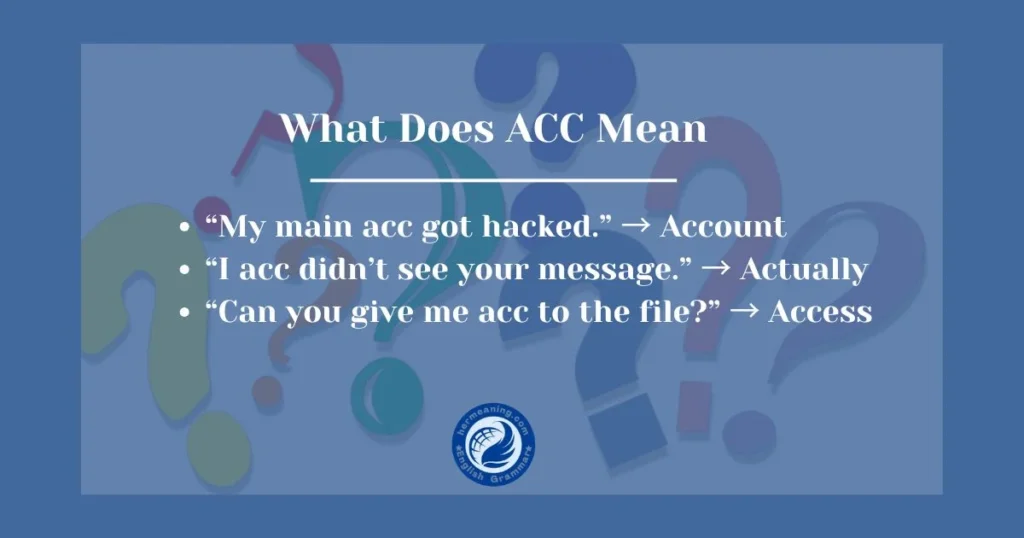
The abbreviation “acc” has multiple meanings, but the most common ones include:
- Account (most common on social media)
- Actually (common in texting slang)
- Access (less common, tech-related use)
- Accident / ACC (context-specific)
Simple examples:
- “My main acc got hacked.” → Account
- “I acc didn’t see your message.” → Actually
- “Can you give me acc to the file?” → Access
Short quotes in real usage:
- “This is my backup acc, follow me here.”
- “I acc love this song.”
- “He lost his acc yesterday.”
The meaning always depends on context, not just the word itself.
4️⃣ Origin & Background
The abbreviation “acc” didn’t come from formal English. It grew naturally from internet culture.
In early online forums and gaming communities, typing fast mattered. People started shortening words like:
- account → acc
- actually → acc
- access → acc
As social media platforms like Instagram, Twitter (X), and Snapchat grew, these shortcuts became part of everyday communication.
Cultural influence:
- Gaming communities used “acc” for accounts heavily
- Gen Z adopted it as slang for “actually”
- Social media creators used it for branding and multiple profiles
Today, “acc” is globally recognized in digital conversations, especially among younger users.
5️⃣ Real-Life Conversations (MANDATORY)
💬 WhatsApp Conversation
Person A: Did you see my new Instagram?
Person B: Which acc? Your main or backup?
Person A: Backup acc, I post memes there 😂
💬 Instagram DM
Person A: You unfollowed me?
Person B: No, I acc deactivated for a while
💬 TikTok Comment Section
Person A: This edit is insa*e 🔥
Person B: I acc spent 5 hours on it
💬 Text Message
Person A: Are you coming today?
Person B: I acc forgot about the meeting 😭
These conversations show how flexible “acc” is in real communication.
6️⃣ Emotional & Psychological Meaning
“ACC” may look like just a shortcut, but it reflects something deeper about modern communication.
People use it because:
- They want to speak faster
- They prefer casual, relaxed tone
- They are part of digital culture identity
Emotional tone behind it:
- “actually” usage → honesty or correction
- “account” usage → identity or online presence
- “access” usage → permission or control
Psychological insight:
Using abbreviations like “acc” makes conversations feel:
- Faster
- Less formal
- More personal
Real-life scenario:
Imagine you’re texting a friend late at night. Instead of writing:
“I actually didn’t check the message earlier.”
You simply type:
“I acc didn’t see it.”
It feels lighter, more natural, and emotionally casual.
7️⃣ Usage in Different Contexts
📱 Social Media
- “Follow my finsta acc”
- “This acc is my backup page”
💬 Friends & Relationships
- “I acc miss you”
- “I acc forgot your birthday 😭”
💼 Work / Professional Settings
- Rarely used in formal communication
- Could appear in internal chats: “Give me access (acc) to folder”
🗣️ Casual vs Serious Tone
- Casual: Very common
- Serious: Avoid using “acc” unless context is informal
8️⃣ When NOT to Use It
Even though “acc” is popular, there are times you should avoid it:
- Formal emails
- Job applications
- Academic writing
- Professional reports
Why?
Because it can:
- Look unprofessional
- Create misunderstanding
- Reduce clarity in serious communication
In short: use it only when the tone is casual.
9️⃣ Common Misunderstandings
Many people get confused because “acc” has multiple meanings.
Common mistakes:
- Thinking it always means “account”
- Misreading “acc” as a typo
- Confusing it with “AC” or “ACC sports conference”
Tone confusion:
- “I acc hate this” → means “I actually hate this” (strong emotion)
- “My acc is gone” → means account lost
Literal vs slang:
- Literal: account / access
- Slang: actually
Context is everything.
🔟 Comparison
| Concept | Meaning Intent | Usage Intent | Example Intent |
|---|---|---|---|
| acc (account) | Refers to online profile | Social media identity | “This is my private acc” |
| acc (actually) | Used for emphasis | Casual correction | “I acc didn’t know” |
| acc (access) | Permission/entry | Tech/system use | “Give me acc to folder” |
| acc vs full words | Short vs formal English | Informal communication | “acc vs actually usage” |
Key Insight
“ACC” works as a flexible digital shortcut. Its meaning always depends on the situation, not the word itself.
1️⃣1️⃣ Examples
1. acc (account)
- Meaning: online profile
- Used in: social media
- Example: “new acc follow me”
2. acc (actually)
- Meaning: truth/emphasis
- Used in: texting slang
- Example: “I acc forgot”
3. acc (access)
- Meaning: permission
- Used in: tech/work
- Example: “give acc to files”
4. ACC (capitalized)
- Meaning: formal acronym (varies)
- Used in: organizations/sports
- Example: “ACC tournament”
5. finsta acc
- Meaning: fake Instagram account
- Used in: Gen Z culture
- Example: “my private finsta acc”
6. main acc
- Meaning: primary account
- Used in: social media
- Example: “this is my main acc”
7. backup acc
- Meaning: secondary account
- Used in: online platforms
- Example: “follow my backup acc”
8. priv acc
- Meaning: private account
- Used in: Instagram culture
- Example: “I moved to priv acc”
9. acc dm
- Meaning: account-related message
- Used in: chat slang
- Example: “check your acc dm”
10. acc leak
- Meaning: exposed account
- Used in: online security talk
- Example: “my acc got leaked”
1️⃣2️⃣ How to Respond When Someone Uses It
😄 Casual replies:
- “Which acc are you talking about?”
- “Oh that acc? Got it 👍”
😂 Funny replies:
- “Which acc? You’ve got like 5 😭”
- “Your secret agent acc again?”
🙂 Mature replies:
- “Do you mean your account or actual message?”
- “Can you clarify ‘acc’ please?”
🙏 Respectful replies:
- “Thanks for sharing your account.”
- “I understand your point.”
1️⃣3️⃣ Regional & Cultural Usage
🌍 Western culture
- Mostly means “actually” or “account”
- Very common in texting slang
🌏 Asian culture
- Popular in gaming and social media
- “acc” often means accounts in Instagram culture
🕌 Middle Eastern culture
- Used in online chats and gaming
- Less formal usage, mostly youth-driven
💻 Global internet usage
- Universal slang across platforms
- Context defines meaning
👶 Generational differences
- Gen Z: uses it daily in slang
- Millennials: use it less, more formal
- Older users: often confused by it
1️⃣4️⃣ Is It Safe for Kids?
Yes, “acc” itself is safe. It is just an abbreviation.
However, kids should understand:
- Context matters
- It can appear in slang-heavy conversations
- Not all meanings are formal
Parents don’t need to worry about the word itself.
1️⃣5️⃣ FAQs
1. What does acc mean in texting?
It usually means “actually” or “account” depending on context.
2. Is acc a slang word?
Yes, it is internet slang used in casual communication.
3. What does acc mean on Instagram?
It typically means “account.”
4. Can acc mean access?
Yes, but it is less common and usually technical.
5. Is acc formal or informal?
It is informal and should not be used in professional writing.
6. Why do people use acc instead of actually?
To type faster and keep conversations casual.
7. Does acc always mean the same thing?
No, its meaning changes with context.
1️⃣6️⃣ Conclusion
The abbreviation “acc” may look small, but it carries big meaning in digital communication. It reflects how language is evolving in the online world—faster, simpler, and more expressive.
Once you understand its context, you’ll notice it everywhere in chats, comments, and social media posts.
Instead of feeling confused next time you see it, you’ll instantly know whether someone means account, actually, or access.
Language keeps changing, and “acc” is a perfect example of how we adapt to speak faster in a digital world.