
At first glance, it looks strange. Almost like a typo or some secret code. But in reality, it carries a very important meaning in digital communication.
People search “What Does /s Mean” because online tone is hard to read. A message that seems serious might actually be sarcasm. And without voice or facial expressions, misunderstandings happen all the time.
That tiny “/s” solves a big problem. It helps people signal sarcasm clearly, avoiding confusion in texting, social media, and comment threads.
In this guide, you’ll understand exactly what it means, where it comes from, and how people use it in real conversations.
What Does /s Mean – Quick Meaning
The shorthand /s stands for sarcasm.
It is used in written text to show that the previous statement is not serious.
In simple terms:
- It tells the reader: “Don’t take this literally.”
- It marks sarcasm or irony.
- It prevents misunderstanding in online conversations.
Examples:
- “Oh great, another Monday… /s”
- “I just love doing taxes /s”
- “Yeah, this is my favorite assignment /s”
Without “/s,” these sentences might sound real. With it, the tone becomes clear.
Origin & Background
The “/s” notation comes from early internet culture, especially forums and communities where tone was often misunderstood.
Platforms like Reddit and early message boards played a huge role in its spread. Users needed a simple way to show sarcasm without adding long explanations.
Instead of writing:
“I’m being sarcastic”
They started using:
“/s”
Over time, it became a standard part of online communication.
Today, it is widely recognized across social media platforms like Twitter (X), Instagram comments, Discord, and Reddit threads.
It reflects a deeper shift in digital language—where emotion and tone need symbols, not just words.
Real-Life Conversations (MANDATORY)
WhatsApp Conversation:
Person A: I studied all night and still failed 😭
Person B: Wow, genius level effort /s
Instagram DM:
Person A: My phone died again at 2%
Person B: That’s the most reliable battery ever /s
TikTok Comments:
User1: This dance is super easy
User2: Yeah totally, I nailed it on my first try /s
Text Message:
Friend A: I love waking up at 5 AM
Friend B: Sure, everyone’s dream life /s
These examples show how “/s” prevents confusion and adds emotional clarity.
Emotional & Psychological Meaning
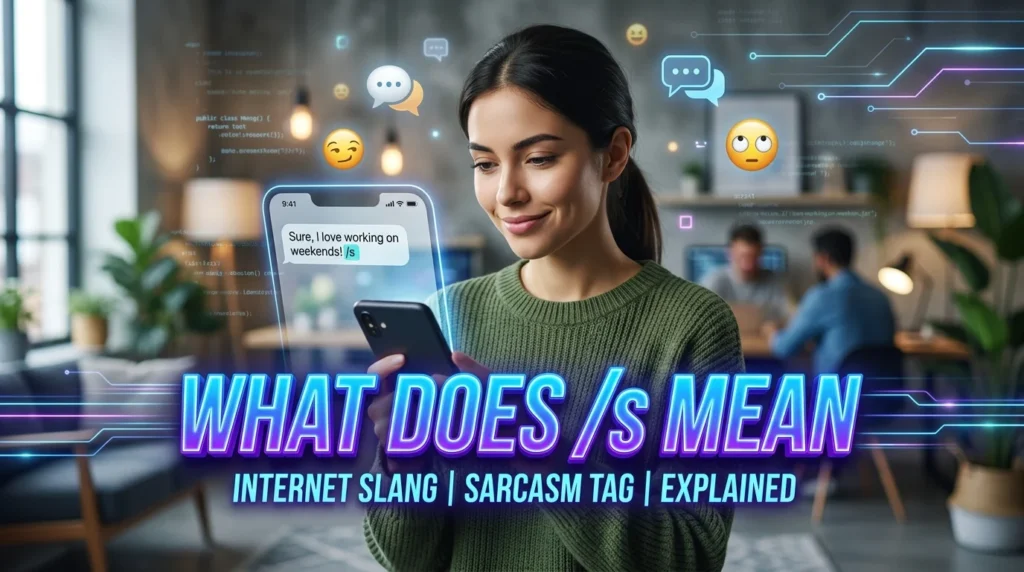
The use of /s is more than just grammar—it reflects how people communicate emotions online.
Sarcasm is a natural part of human expression. In face-to-face conversations, tone, facial expressions, and gestures make it obvious. Online, that context disappears.
So people use /s to:
- Avoid being misunderstood
- Add humor safely
- Express frustration without conflict
- Keep conversations light
Psychologically, it reduces “digital misreading anxiety”—the fear that someone will take a joke seriously.
Personal-style scenario:
Imagine sending a sarcastic joke to a friend without “/s.” They might think you are angry or serious. But with “/s,” everything feels safe, clear, and playful. It protects relationships from unnecessary tension.
Usage in Different Contexts
Social Media
Used in comments to clarify jokes or sarcasm in fast-moving threads.
Friends & Relationships
Helps avoid misunderstandings in casual chats where tone matters.
Work / Professional Settings
Rarely used. Sarcasm in workplace messages can be risky, even with “/s.”
Casual vs Serious Tone
- Casual: Very common and accepted
- Serious: Often avoided to maintain clarity and professionalism
When NOT to Use It
Even though /s is helpful, it is not always appropriate.
Avoid using it when:
- Talking to someone unfamiliar with internet slang
- Communicating in formal emails
- Discussing sensitive topics
- Writing professional or academic content
- The audience may misinterpret sarcasm anyway
Cultural misunderstanding can still happen even with “/s,” especially across different regions.
Common Misunderstandings
Many people misread /s when they first see it.
Common mistakes include:
- Thinking it means “serious”
- Confusing it with programming syntax
- Assuming it changes grammar instead of tone
- Believing it is unnecessary or confusing
The biggest misunderstanding is assuming words alone always carry tone. Online communication proves they don’t.
Comparison Table
| Concept | Meaning Intent | Usage Intent | Example Intent | Comparison Insight |
|---|---|---|---|---|
| What Does /s Mean | Shows sarcasm in text | Clarifies tone | “Great job /s” | Prevents misreading tone |
| How to Use /s | Add after sarcastic sentence | End of statement | “Nice weather /s” | Simple tone marker |
| Examples of /s | Real usage samples | Shows context | “Perfect timing /s” | Helps learning |
| /s vs sarcasm without marker | Explicit vs implied sarcasm | Online vs offline use | Spoken irony vs text | Digital clarity tool |
Key Insight:
“/s” is not about grammar rules—it is about emotional clarity in digital communication where tone cannot be heard.
Variations / Types (Minimum 8–10)
- /s meaning – sarcasm marker in text
Used to show irony clearly - /sarcasm – full form
Written version of /s for clarity - /j meaning – joking
Used for light humor instead of sarcasm - /gen meaning – genuine
Shows seriousness or honesty - /srs meaning – serious
Indicates no joke is intended - /lh meaning – lighthearted
Softens tone in casual chats - /t meaning – teasing
Used for playful remarks - /hj meaning – half joking
Mix of serious and humor - /nm meaning – not mad
Used to calm emotional tone - /pos meaning – positive
Clarifies supportive intent
These variations show how digital language is evolving into a full emotional coding system.
How to Respond When Someone Uses It
Casual replies:
- “Haha got it 😄”
- “That was funny /s made it clear”
Funny replies:
- “Glad you clarified before I took offense 😂”
- “I almost believed you for a second”
Mature replies:
- “Understood, sarcasm noted”
- “Thanks for clarifying the tone”
Respectful replies:
- “I see your point, thanks for explaining”
- “Appreciate the clarity”
Regional & Cultural Usage
Western culture:
Widely understood, especially in Reddit and Twitter communities.
Asian culture:
Still growing in use; many users prefer emojis instead.
Middle Eastern culture:
Less common in formal messaging but used in youth digital spaces.
Global internet usage:
Becoming universal among Gen Z users.
Generational differences:
- Gen Z: Frequently uses /s and similar markers
- Millennials: Understand it but use it less
- Older generations: Often unfamiliar with it
Is It Safe for Kids?
Yes, /s is generally safe for kids because it is simply a tone indicator.
However, children may not always understand sarcasm itself, so context matters. Parents or educators should explain its meaning in digital communication.
FAQs
What does “/s” mean?
“/s” means sarcasm in online chats. It shows the message is not serious and should be taken as a joke or irony.
What is the meaning of hot 🥵?
“Hot 🥵” usually means something or someone is very attractive, stylish, or physically attractive. It can also describe extreme heat or intensity.h
What is SSA in Gen Z slang?
“SSA” can have different meanings depending on context, but in Gen Z slang it is often used as shorthand in casual chats or niche communities. Its meaning changes with usage and platform.
What does the S mean in a chat?
“S” in chat can mean sarcasm marker (/s), or sometimes “same,” or simply refer to plural/suffix depending on context. Meaning depends on how it is used.
Is /s used for sarcasm only?
Yes, in most online communities, /s is used to clearly indicate sarcasm so the message is not misunderstood.
Why do people use tone indicators like /s?
People use tone indicators to avoid confusion in text-based communication where voice and facial expressions are missing.
Is hot 🥵 always romantic?
No, it can also mean spicy food, strong weather, or intense situations, not only romantic attraction.
Is SSA a common slang term?
SSA is not universally common slang. It is more context-based and may vary across platforms or communities.
Can /s be used in formal writing?
No, /s is informal internet slang and should not be used in professional or academic writing.
What happens if you don’t use /s?
Without /s, sarcastic messages can be misunderstood as serious, leading to confusion or miscommunication.
Conclusion
The /s marker is a small but powerful tool in digital communication. It helps people express sarcasm clearly in a world where tone is often lost. By using it, you reduce misunderstandings and keep conversations smooth and playful. Whether in chats, comments, or social media posts, /s adds emotional clarity. As online language evolves, such markers become essential for expressing human intent. Understanding it helps you communicate more confidently and avoid unnecessary confusion in everyday digital interactions.