Language online moves fast, and some words carry more emotional weight than others. One of those words is “skank.”
People search what does skank mean because they hear it in songs, social media comments, or heated arguments and feel confused—or even offended. The word can sound harsh, confusing, or culturally loaded depending on who uses it and how.
At its core, “skank” is not just a simple slang term. It reflects judgment, emotion, and sometimes insult. But its meaning has shifted over time, and understanding it helps you navigate conversations, avoid misunderstandings, and communicate more confidently online and offline.
This guide breaks it down in a clear, real-world way so you fully understand what people actually mean when they use it.
What Does Skank Mean – Quick Meaning
The word “skank” is a slang insult used to describe someone—usually a woman—in a disrespectful way, often implying:
- Promiscuous behavior (real or assumed)
- Dirty or low-class appearance (informal insult)
- Untrustworthy or morally judged behavior
It is important to note:
The word is highly offensive in many contexts and can be hurtful.
Common usage examples:
- “She called her a skank after the argument.”
- “That comment was so rude, why would you say skank like that?”
- “People online throw the word skank around too easily.”
In some rare contexts, it has been used loosely in music or slang culture, but it still carries a negative tone.
Origin & Background
The word “skank” has a layered history.
Originally, it is believed to have emerged in American slang during the 1960s–1970s, though its exact roots are debated. It later became widely recognized through:
- Urban street slang
- Pop culture references
- Hip-hop and punk music scenes
- Internet culture and meme language
Over time, its meaning shifted from vague slang to a direct insult targeting appearance or sexual behavior assumptions.
Cultural influence
In music and entertainment, controversial slang often spreads quickly. Words like “skank” gained traction because:
- They were used in lyrics for shock value
- Social conflicts amplified them online
- Teen and youth communities adopted them without full awareness of meaning
Social media impact
Platforms like TikTok, Instagram, and Twitter accelerated its usage. Today, it often appears in comment sections during arguments, where tone and intent are not always clear.
Real-Life Conversations (MANDATORY)
WhatsApp Chat Example
Person A: Did you see what she posted last night?
Person B: Yeah… people in the comments are calling her a skank.
Person A: That’s harsh. They don’t even know her.
Instagram DM Example
Person A: Why did she block me?
Person B: Someone told her you called her a skank in the group chat.
Person A: I didn’t even mean it like that… it just got misunderstood.
TikTok Comment Section
User1: Why is everyone being so mean?
User2: They’re just trolling and calling her skank for attention.
User3: That word is getting way overused and toxic now.
Text Message Exchange
Friend A: I got into an argument today.
Friend B: What happened?
Friend A: Someone literally called me a skank for no reason.
Friend B: That’s not okay. Don’t take that seriously.
Emotional & Psychological Meaning
The word “skank” is not just slang—it carries emotional weight.
It often reflects:
- Anger during conflict
- Judgment about appearance or behavior
- Social power dynamics
- Emotional impulsivity in arguments
People usually use it when they want to hurt, shame, or provoke a reaction.
What it reveals about modern communication
Online spaces reduce empathy. Short comments become emotional weapons. Words like “skank” show how quickly language can turn aggressive when:
- People hide behind screens
- Emotions escalate fast
- Context is missing
Short real-life scenario
A small misunderstanding in a group chat escalates. One insult gets thrown out in anger. Suddenly, the conversation shifts from discussion to personal attack. That’s how words like this often enter digital arguments—not thoughtfully, but emotionally.
Usage in Different Contexts
Social media
Used in comment fights, drama threads, or trolling behavior. Often seen as toxic language.
Friends & relationships
Rare but sometimes used in heated arguments or jealousy-driven conflicts.
Work / professional settings
Completely inappropriate. Using it here can damage reputation and relationships.
Casual vs serious tone
- Casual: still offensive, even if “joking”
- Serious: deeply insulting and confrontational
When NOT to Use It
Avoid using “skank” in:
- Professional conversations
- Academic or formal discussions
- Mixed social groups
- Public online posts
- Situations involving misunderstanding or conflict resolution
Even if intended as a joke, it can easily be misinterpreted and escalate tension.
Common Misunderstandings
Many people misunderstand this word.
1. “It’s just slang”
No—it’s slang, but still offensive.
2. “Everyone uses it online”
Popularity doesn’t make it appropriate.
3. “It only means appearance”
It often targets moral judgment, not just looks.
4. “It’s harmless banter”
Context matters. It can be deeply hurtful.
Comparison Table
| Concept | Meaning Intent | Usage Intent | Example Intent | Comparison Insight |
|---|---|---|---|---|
| What Does “Skank” Mean | Insult/slang for judgmental label | Used to insult or shame | “She called her a skank” | Strong negative emotional slang |
| How to Use “Skank” | Describes offensive slang usage | Rarely appropriate | Not recommended usage | Avoid in respectful communication |
| Examples of “Skank” | Real usage in speech or text | Seen in arguments | Social media insults | Mostly conflict-driven usage |
| Skank vs “Promiscuous” | Slang vs neutral descriptor | One is insulting, one is neutral | “Promiscuous behavior” vs “skank” | One is clinical, one is offensive |
Key Insight:
The word “skank” is emotionally charged slang that replaces neutral description with judgment, making it socially risky and often inappropriate.
Variations / Types (8–10)
1. Skank (slang)
Direct insult used in arguments.
2. Skanky (adjective)
Used to describe appearance or vibe negatively.
3. Skank behavior
Refers to judged actions or conduct.
4. Skanked (past tense slang)
Rare usage implying someone acted in a judged way.
5. Skank vibe
Informal insult about perceived energy or style.
6. Online skank
Internet slang used in comment sections.
7. “She’s a skank” (phrase)
Direct personal insult.
8. Skank talk
Aggressive or insulting speech style.
9. Skank accusation
Claiming someone behaves immorally (judgment-based).
10. Skank slang usage
General internet slang reference.
How to Respond When Someone Uses It
Casual replies
- “That’s not really fair to say.”
- “Let’s not use that kind of word.”
Funny replies
- “Wow, drama level: unlocked.”
- “That escalated quickly.”
Mature replies
- “I don’t agree with labeling people like that.”
- “Let’s keep this respectful.”
Respectful replies
- “I think we should avoid hurtful language.”
- “There’s a better way to express that.”
Regional & Cultural Usage
Western culture
Often seen in music, slang, and online arguments. Highly offensive in serious contexts.
Asian culture
Less common in everyday language but understood through social media exposure.
Middle Eastern culture
Generally viewed as disrespectful and inappropriate in most social settings.
Global internet usage
Mostly appears in comment sections, memes, and viral drama.
Generational differences
- Gen Z: Uses it more in online slang, sometimes casually
- Millennials: More likely to see it as offensive and avoid it
Is It Safe for Kids?
No.
The word carries adult-level judgment and sexual implication in many contexts. It is not appropriate for children’s communication spaces or learning environments. Parents and educators generally discourage its use due to its insulting nature.
FAQs
What is a shank slang for?
In slang, “shank” usually means a homemade knife or stabbing weapon, often used in prisons or violent contexts. It can also be used as a verb meaning to stab someone. It is a serious and violent term.
What does skanking mean in slang?
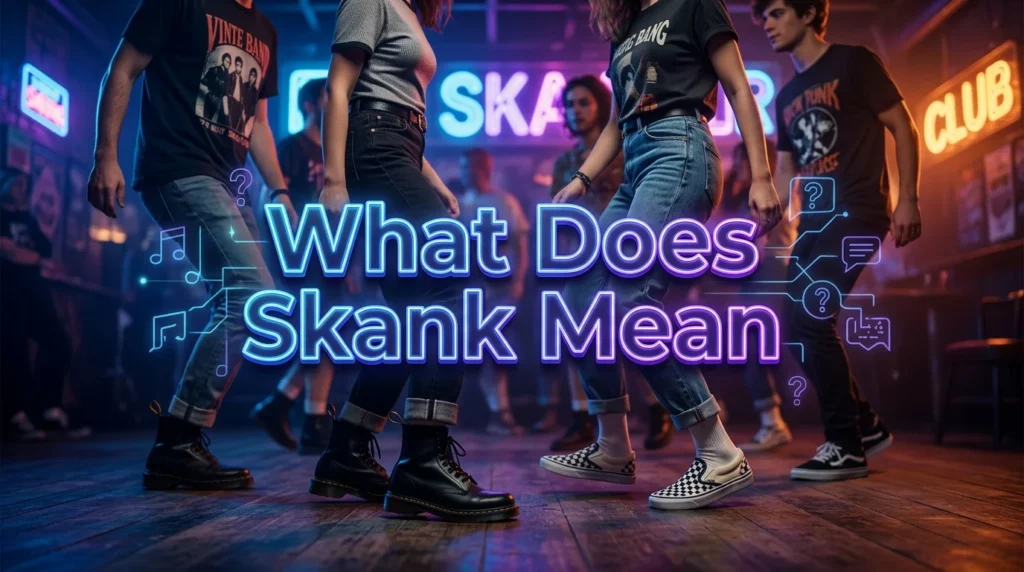
Skanking refers to a type of energetic dance style linked to ska, punk, and reggae music. It involves fast-paced, rhythmic movements, often jumping and swinging arms in a lively way.
What does the slang word stank mean?
“Stank” is informal slang for something that smells very bad. It can also describe someone acting in an unpleasant or disrespectful way depending on context.
What is a skink in slang?
In slang, “skink” is not widely used, but outside slang it refers to a type of lizard. In some casual speech, people may jokingly use it as a nickname, but it has no strong mainstream slang meaning.
Is “shank” always violent slang?
Yes, in most modern slang usage, “shank” strongly refers to stabbing or improvised weapons, especially in prison or street-related contexts.
Is skanking a positive or negative word?
Skanking is generally positive or neutral, especially in music culture. It describes a fun, expressive dance rather than anything offensive.
Can “stank” be used as an insult?
Yes. While it often refers to bad smell, it can also be used casually to insult someone’s attitude or behavior in a playful or rude way.
Where is skanking commonly used?
It is most common in music scenes like ska, punk, and reggae concerts, where people dance energetically to fast beats.
Is “shank” used outside crime contexts?
Sometimes yes. In sports slang (like football/soccer), “shank” can also mean kicking or hitting the ball poorly, but this is less common.
Are “skank,” “stank,” and “skank” related words?
No. They sound similar but have different meanings:
Stank → bad smell slang
They are unrelated in origin and usage.
Skank → offensive insult
Skanking → dance style
Conclusion
Understanding what “skank” means helps you navigate modern conversations with clarity and confidence. It is not just slang but a loaded insult shaped by emotion, culture, and online behavior. While you may encounter it on social media or in arguments, using it yourself can create misunderstanding or harm. Choosing respectful language always communicates maturity and control. In today’s fast-moving digital world, knowing the weight of words like this keeps your communication smarter, safer, and more effective.