
If you’ve ever looked at a large number like 5,482 and wondered why teachers keep asking students to “write it in expanded form,” you’re not alone.
Many parents, students, and even adults search for the meaning of expanded form because math vocabulary can sound more complicated than the actual idea. The good news? Expanded form is one of the easiest and most useful concepts in basic math once someone explains it clearly.
At its core, expanded form helps you see the true value hidden inside every digit. Instead of viewing a number as one giant block, you break it apart into smaller pieces based on place value.
That’s why schools teach it early. It strengthens number sense, improves mental math, and helps children understand how numbers actually work.
In this guide, you’ll learn:
- What expanded form really means
- How kids use it in school
- The difference between expanded form, standard form, and word form
- Real examples you can practice immediately
- Common mistakes people make
- Why this math skill matters in everyday life
By the end, large numbers will feel far less intimidating.
What Does Expanded Form Mean in Maths
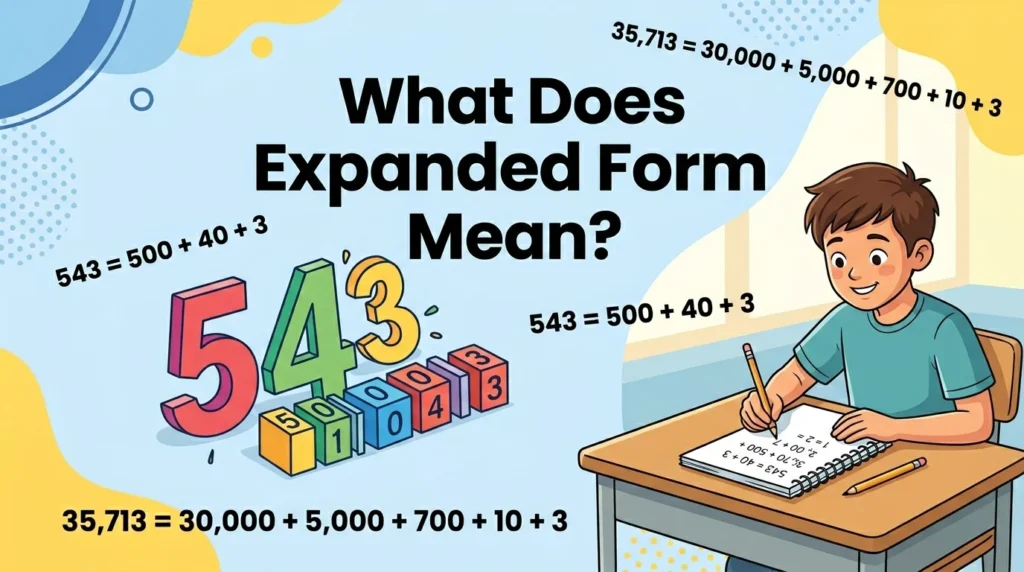
Expanded form in math means writing a number by showing the value of each digit separately.
Instead of writing:
- 4,582
You expand it into:
- 4,000 + 500 + 80 + 2
Each digit is separated according to its place value.
Here’s the idea:
- 4 = 4 thousands
- 5 = 5 hundreds
- 8 = 8 tens
- 2 = 2 ones
So the number becomes:
- 4,000 + 500 + 80 + 2
Quick Definition
Expanded form is a way of writing numbers that shows the value of every digit individually.
Simple Examples
“7,231 = 7,000 + 200 + 30 + 1”
“560 = 500 + 60”
“91 = 90 + 1”
This method helps students understand place value more deeply instead of memorizing numbers mechanically.
What Does Expanded Form Mean for Kids
For kids, expanded form is basically a “number breakdown.”
Teachers often explain it like taking apart a toy to see how every piece works.
A child may see the number 3,456 as just one big number. But expanded form teaches them that the number is made from:
- 3 thousands
- 4 hundreds
- 5 tens
- 6 ones
Kids usually learn expanded form in elementary school because it builds confidence with:
- Addition
- Subtraction
- Reading large numbers
- Mental math
- Problem-solving
A Kid-Friendly Example
Imagine you have:
- 2 chocolate boxes
- 4 candy packs
- 7 small treats
You can think of 247 as:
- 200 + 40 + 7
Suddenly the number feels easier to understand.
What Does Standard Form Mean
Standard form means writing the number normally, the way people usually see it every day.
For example:
- 6,845 → Standard form
Expanded form of the same number:
- 6,000 + 800 + 40 + 5
Word form:
- Six thousand eight hundred forty-five
People often confuse these forms because schools teach them together.
The Three Main Number Forms
| Form Type | Example |
|---|---|
| Standard Form | 6,845 |
| Expanded Form | 6,000 + 800 + 40 + 5 |
| Word Form | Six thousand eight hundred forty-five |
Understanding all three helps students read, write, and interpret numbers more confidently.
How to Write Numbers in Expanded Form
Writing numbers in expanded form becomes simple once you understand place value.
Step-by-Step Method
Take the number:
- 8,572
Step 1: Identify Each Digit
- 8 thousands
- 5 hundreds
- 7 tens
- 2 ones
Step 2: Convert Each Place Value
- 8 → 8,000
- 5 → 500
- 7 → 70
- 2 → 2
Step 3: Add Them Together
- 8,000 + 500 + 70 + 2
That’s expanded form.
Another Example
Number:
- 3,109
Expanded form:
- 3,000 + 100 + 0 + 9
Sometimes teachers skip the zero:
- 3,000 + 100 + 9
Both can be acceptable depending on the classroom style.
Expanded Form Examples
Here are several examples that make the pattern easier to recognize.
| Standard Number | Expanded Form |
|---|---|
| 45 | 40 + 5 |
| 327 | 300 + 20 + 7 |
| 6,482 | 6,000 + 400 + 80 + 2 |
| 90 | 90 + 0 |
| 1,205 | 1,000 + 200 + 5 |
| 70,391 | 70,000 + 300 + 90 + 1 |
Once students practice repeatedly, their brains begin recognizing place value automatically.
What Is Expanded Notation
Expanded notation is very similar to expanded form, but it goes one step deeper.
Instead of writing:
- 4,000 + 500 + 80 + 2
You write:
- (4 × 1,000) + (5 × 100) + (8 × 10) + (2 × 1)
This method shows both:
- The digit
- Its place value multiplier
Teachers use expanded notation to strengthen multiplication understanding alongside place value.
Expanded Form vs Expanded Notation
| Expanded Form | Expanded Notation |
|---|---|
| 500 + 60 + 3 | (5 × 100) + (6 × 10) + (3 × 1) |
Both methods teach the same concept differently.
What Does Word Form Mean in Math
Word form means writing numbers using words instead of digits.
Example:
- 2,451
Word form:
- Two thousand four hundred fifty-one
Expanded form:
- 2,000 + 400 + 50 + 1
Standard form:
- 2,451
Word form helps students improve:
- Reading comprehension
- Spelling
- Numerical understanding
It also helps in real-world situations like:
- Writing checks
- Legal documents
- Financial paperwork
Expanded Form in Words
Sometimes teachers ask students to combine expanded form with word form.
Example:
- 4,328
Expanded form:
- 4,000 + 300 + 20 + 8
Expanded form in words:
- Four thousand plus three hundred plus twenty plus eight
This exercise strengthens both language and math skills at the same time.
Origin & Background
Expanded form comes from the broader mathematical concept called place value.
Ancient number systems often struggled with representing large quantities clearly. Over time, mathematicians developed positional systems where the location of a digit determined its value.
That’s why:
- 5 in 50 means fifty
- 5 in 500 means five hundred
Modern education adopted expanded form because it visually teaches this structure.
Today, social media and online learning platforms have made the term even more common. Parents frequently search it while helping children with homework.
Short educational videos on platforms like TikTok and YouTube have also simplified the concept for younger learners.
Real-Life Conversations
WhatsApp Conversation
Person A:
“My son keeps asking about expanded form. I forgot everything from school.”
Person B:
“It’s easier than it sounds. You just break numbers apart by place value.”
Instagram DM
Person A:
“Why does math have three forms for the same number?”
Person B:
“Because expanded form helps you understand what each digit actually means.”
TikTok Comments
Person A:
“I finally understand expanded form after this video.”
Person B:
“Same. Nobody explained place value this clearly in school.”
Text Message
Person A:
“What’s expanded form for 2,305?”
Person B:
“2,000 + 300 + 5”
Person A:
“Oh wow. That’s it?”
Emotional & Psychological Meaning
Expanded form may seem like a small math lesson, but psychologically, it teaches something powerful: complex things become easier when broken into smaller parts.
That’s one reason children who struggle with large numbers often gain confidence after learning expanded form.
Instead of seeing:
- 9,482
They see:
- 9,000
- 400
- 80
- 2
The number suddenly feels manageable.
A parent helping their child with homework often notices this emotional shift immediately. Confusion turns into relief because the child finally understands why the number works the way it does.
That confidence matters more than memorization.
Usage in Different Contexts
Social Media
Teachers and tutors frequently use expanded form examples in educational videos and homework tips.
Friends & Relationships
Parents often discuss expanded form while helping children study.
Work & Professional Settings
While adults rarely say “expanded form” directly, the concept appears in:
- Accounting
- Data analysis
- Financial breakdowns
Casual vs Serious Tone
In classrooms, expanded form is educational and structured. Online, people sometimes use humor to describe it as “taking numbers apart.”
When NOT to Use It
Expanded form is useful for learning, but not always practical.
Avoid using it:
- In formal financial documents
- In quick calculations
- When standard form is expected
- In advanced math where shorthand matters more
Writing:
- 5,000 + 300 + 40 + 2
instead of:
- 5,342
can slow communication unnecessarily in professional situations.
Common Misunderstandings
People Think It’s Advanced Math
Actually, expanded form is foundational elementary math.
People Forget Zero Place Values
Example:
- 4,005
Correct:
- 4,000 + 5
Not:
- 400 + 5
Confusing Expanded Form With Word Form
Expanded form:
- 700 + 20 + 1
Word form:
- Seven hundred twenty-one
They are completely different formats.
Comparison Table
| Topic | Meaning / Intent |
|---|---|
| What Does Expanded Form Mean | Breaking numbers into place values |
| How to Use Expanded Form | Write each digit separately by value |
| Examples of Expanded Form | 500 + 40 + 3 |
| Expanded Form vs Standard Form | Expanded shows value parts, standard shows full number |
| Expanded Form vs Word Form | One uses values, the other uses words |
| Expanded Notation vs Expanded Form | Notation includes multiplication |
Key Insight
Expanded form is not about making numbers harder. It exists to make numbers easier to understand internally. Once students grasp place value, most arithmetic becomes far less intimidating.
Variations / Types
Expanded form meaning
Shows the value of each digit separately.
Expanded form in text
Used in homework explanations and educational discussions.
Expanded form abbreviation
Sometimes shortened informally as “EF” in classroom notes.
Expanded form slang
There is no true slang version, but students jokingly call it “number stretching.”
Expanded form in chat
Often appears when parents ask for homework help.
Expanded notation meaning
Shows place value using multiplication.
Standard form meaning
The normal way of writing a number.
Word form meaning
Writing numbers fully in words.
Expanded form for decimals
Example:
- 5.67 = 5 + 0.6 + 0.07
Expanded form for large numbers
Example:
- 245,901 = 200,000 + 40,000 + 5,000 + 900 + 1
How to Respond When Someone Uses It
Casual Replies
- “Oh, you mean breaking the number apart?”
- “That’s actually easier than it sounds.”
Funny Replies
- “Math really loves extra steps.”
- “So numbers have secret identities now?”
Mature Replies
- “Expanded form helps students understand place value deeply.”
- “It’s a strong foundation for later math skills.”
Respectful Replies
- “I’d be happy to help explain it.”
- “Once you see the pattern, it becomes simple.”
Regional & Cultural Usage
Western Culture
Expanded form is heavily emphasized in elementary education systems.
Asian Culture
Many Asian schools focus strongly on mental math, making place value understanding extremely important.
Middle Eastern Culture
Expanded form appears in foundational arithmetic teaching and bilingual education systems.
Global Internet Usage
Online tutoring has made the concept more universally accessible than ever before.
Generational Differences
Gen Z often learns through videos and visual explanations. Millennials may remember worksheets and classroom drills instead.
Is It Safe for Kids?
Yes. Expanded form is completely educational and age-appropriate.
In fact, it helps children:
- Build confidence
- Understand place value
- Improve problem-solving skills
- Strengthen mental math abilities
The key is teaching it patiently without making children feel pressured.
FAQs
What does expanded form mean in simple words?
It means breaking a number into smaller parts based on place value.
What is the expanded form of 256?
- 200 + 50 + 6
Is expanded form the same as expanded notation?
Not exactly. Expanded notation also includes multiplication symbols.
Why do schools teach expanded form?
It helps students understand how numbers are built.
What is standard form in math?
Standard form is writing the number normally, like 4,582.
Can decimals be written in expanded form?
Yes. Example:
- 3.45 = 3 + 0.4 + 0.05
Is expanded form important?
Yes. It builds strong number sense and supports future math learning.
What Is an Expanded Form for Example?
Expanded form means writing a number by showing the value of each digit separately. For example, the number 456 becomes 400 + 50 + 6. This method helps students understand place value more clearly and improves basic math skills.
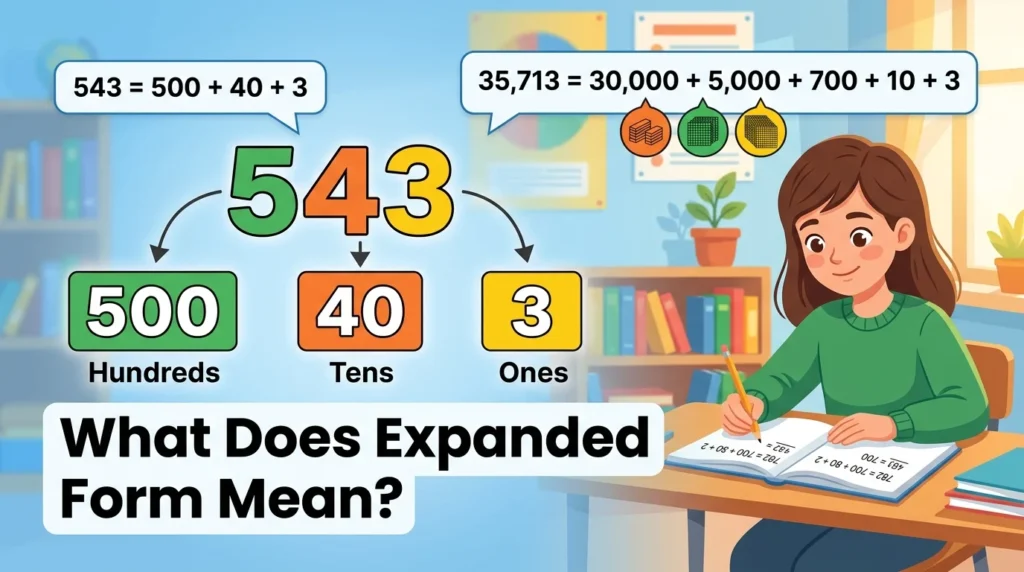
What Is 35713 in Expanded Form?
The expanded form of 35,713 is 30,000 + 5,000 + 700 + 10 + 3. Each digit is separated according to its position in the number. This makes large numbers easier to read and understand.
What Is the Expanded Form of 543?
The expanded form of 543 is 500 + 40 + 3. The number is broken into hundreds, tens, and ones. This helps children learn how each digit contributes to the total value.
How to Write “I Love You” in Math?
People sometimes write “I love you” in math using symbols or playful number codes like 143, where 1 stands for “I,” 4 for “love,” and 3 for “you.” It’s not an official math rule, but it became popular in texting and internet culture. Many couples use it as a cute shorthand expression online.
What Does Expanded Form Mean in Math?
Expanded form in math means expressing a number as the sum of each digit’s place value. Instead of writing one complete number, you split it into parts like thousands, hundreds, tens, and ones. This method builds strong number sense and mental math confidence.
How Do You Teach Expanded Form to Kids?
Teachers usually teach expanded form using blocks, charts, and simple number breakdowns. Kids learn faster when they connect numbers with visual examples and real-life objects. Repetition and small exercises help them understand place value naturally.
Why Is Expanded Form Important?
Expanded form is important because it teaches students how numbers are built. It improves addition, subtraction, estimation, and overall math understanding. Children who master place value often perform better in advanced math later.
What Is the Difference Between Expanded Form and Standard Form?
Standard form shows the number normally, like 4,582, while expanded form breaks it apart into 4,000 + 500 + 80 + 2. Both represent the same number but in different styles. Expanded form focuses more on place value understanding.
Can Decimals Be Written in Expanded Form?
Yes, decimals can also be written in expanded form by separating each decimal place value. For example, 5.72 becomes 5 + 0.7 + 0.02. This helps students understand tenths and hundredths more clearly.
What Is Expanded Notation in Math?
Expanded notation is similar to expanded form but also includes multiplication. For example, 543 can be written as (5 × 100) + (4 × 10) + (3 × 1). This method shows exactly how place value works mathematically.
How Do You Write Large Numbers in Expanded Form?
To write large numbers in expanded form, separate each digit according to its place value. For example, 82,491 becomes 80,000 + 2,000 + 400 + 90 + 1. Breaking numbers apart makes them easier to analyze and solve mentally.
Conclusion
Expanded form may look confusing at first, but it actually makes numbers easier to understand. Instead of memorizing digits blindly, you learn the real value behind each number. That simple shift improves confidence, mental math, and overall problem-solving skills. Whether you’re a student, parent, or teacher, understanding expanded form creates a stronger foundation for everyday math. Once you start breaking numbers apart by place value, large numbers stop feeling overwhelming and begin making complete sense naturally.